


Behringer NEUTRON

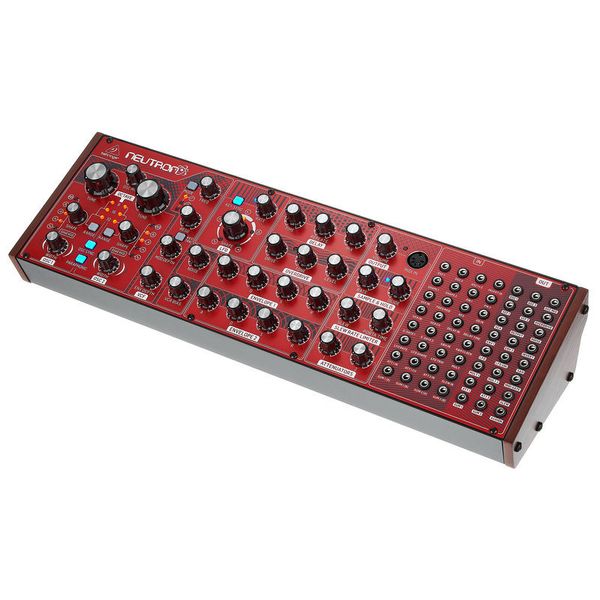
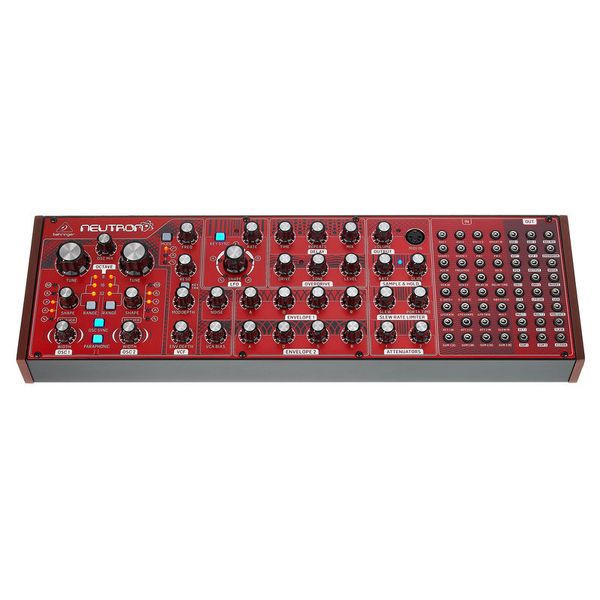
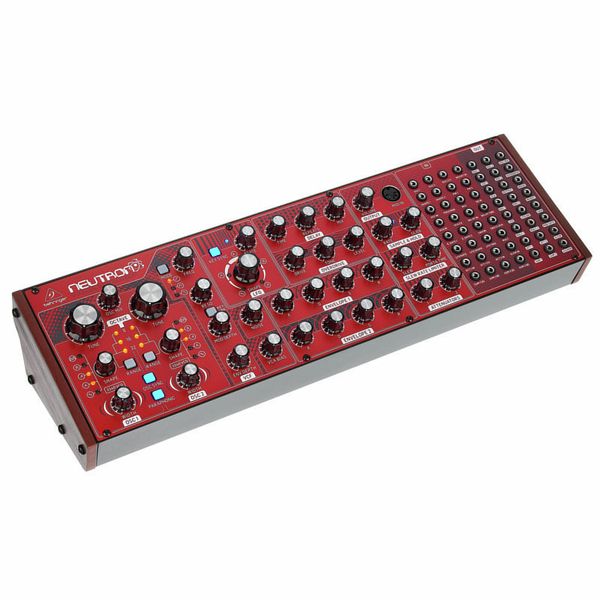


Semi-Modular Desktop Synthesiser
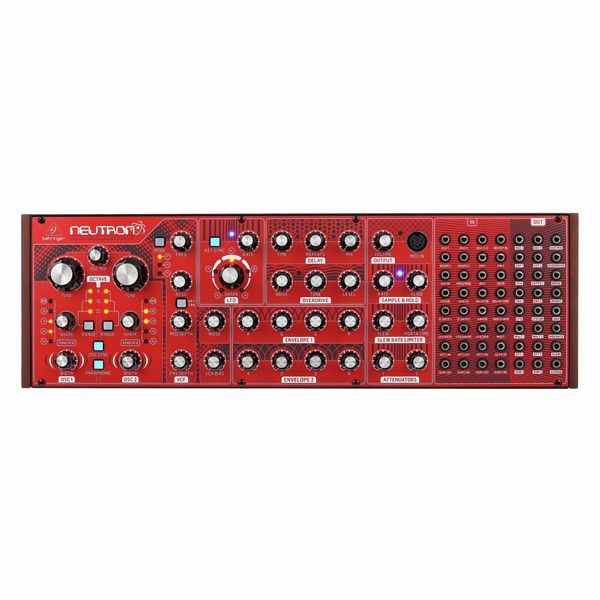
- Analogue signal path
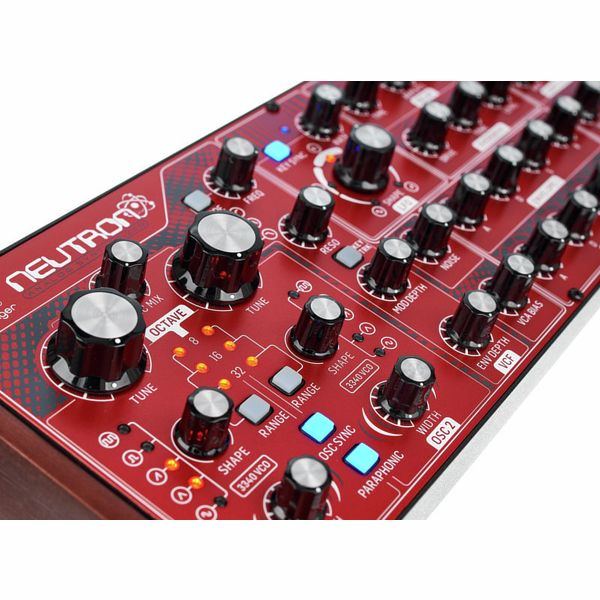
- 2 VCOs with CEM3340 chips
- Continuous transition between 5 waveforms
- Paraphony mode for two-part sounds
- Multimode VCF with resonance
- 2 Analogue ADSR envelopes for VCF and VCA
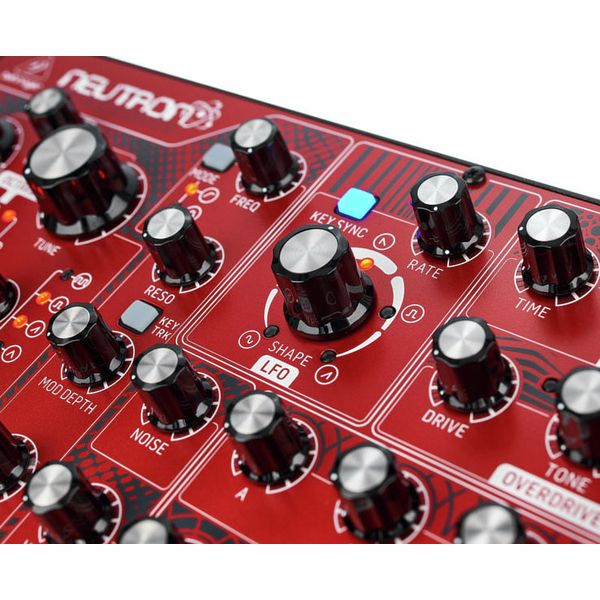
- Flexible LFO with 5 waveforms and MIDI sync
- Analog BBD delay
- Noise generator
- Overdrive circuit
- 43 Control elements for direct access
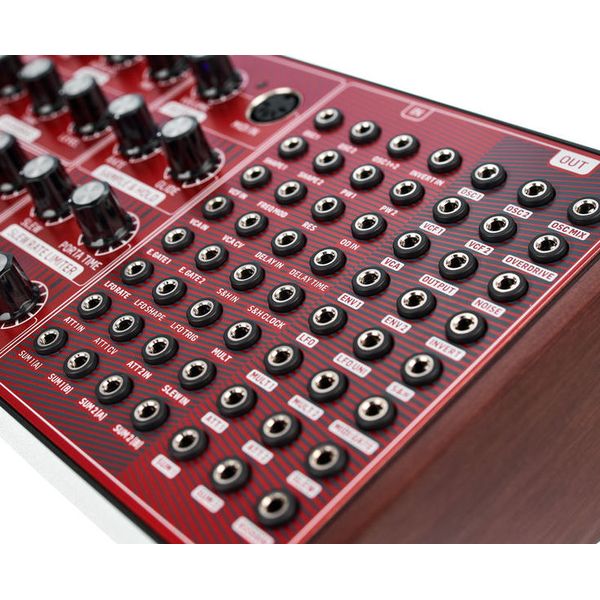
- Jack matrix with 32 inputs, 24 outputs for enhanced sound and connectivity with other modular synthesisers & sequencers
- Can be used as a complete Eurorack synthesiser voice (width: 80 HP)
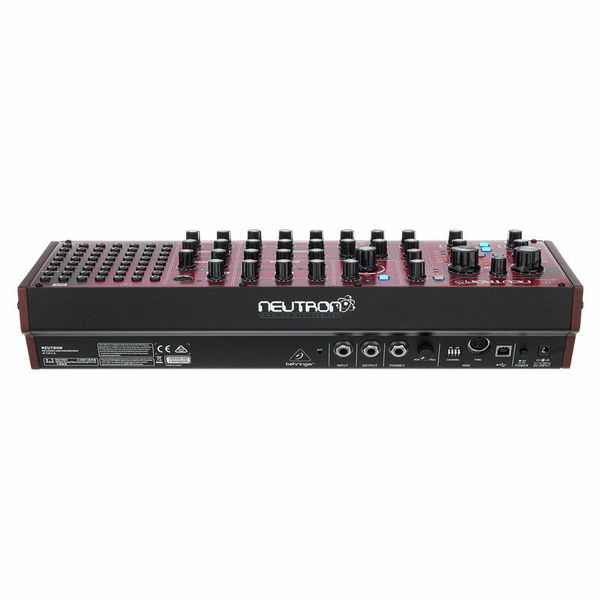
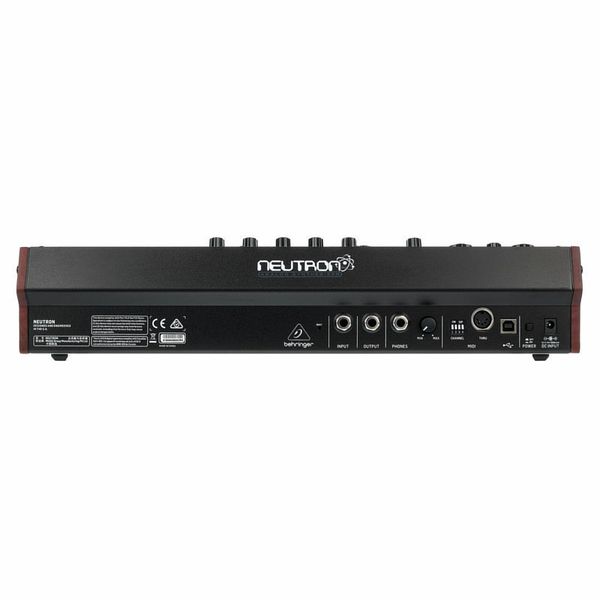
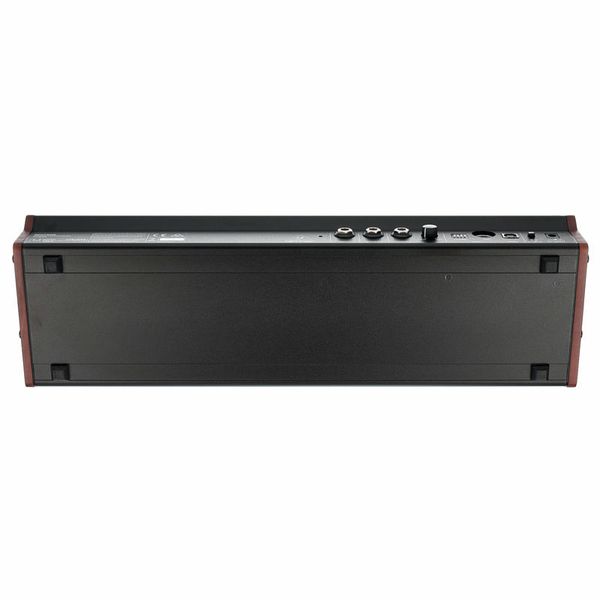
- MIDI In / Thru and USB-MIDI
- 6.3 mm audio input for sound processing from external sources
- 6.3 mm headphone output
- 6.3 mm line output
- Dimensions: 94 x 424 x 136 mm
- Weight: 2.0 kg
- Power adapter included (12 V DC, 1000 mA)
- Suitable protective cover: Article no. 477466 (not included)
- Suitable cases: Art.#480286, Art.483005 (both not included)
-
Available since September 2018
-
Item number 447870
-
Sales Unit 1 piece(s)
-
Design Desktop
-
Polyphony 1
-
Sound Generation Analog, Synthesis
-
MIDI interface 1x In, 1x Thru
-
Storage Medium None
-
USB-port Yes
-
Effects Yes
-
Arpeggiator No
-
Number of Analog Outputs 1
-
Digital Output No
-
Display No
-
Optional Expansions 0
-
Special Features semi modular, Eurorack compatible
-
Paraphonic Eurorack synth, made in the UK
Developed by Behringer's UK-based MIDAS team, the Behringer Neutron is a paraphonic semi-modular analogue synthesizer built entirely in-house. Its dual 3340 VCOs - faithful recreations of the classic Curtis chips found in instruments like the Roland SH-101 and Oberheim OB-Xa - deliver a rich, musical tone that blends vintage warmth with modern stability. The Neutron's paraphonic mode allows both oscillators to be played independently, enabling expressive two-note harmonies and layered textures. With a fully analogue signal path, 36 hands-on controls and Eurorack compatibility, it offers pure synthesis power right out of the box, no patching required.

)
Dual oscillators for classic leads
Each of the Behringer Neutron's oscillators provides five continuously morphable waveforms - sine, triangle, sawtooth, square, and pulse-width modulation - that can be blended or modulated in real time for evolving timbres. Independent tuning and a wide range selection add flexibility for both melodic and experimental use, and the Neutron also features a noise generator, sample & hold, MIDI-syncable LFO, and dual ADSR envelopes for intricate modulation. To complete the signal chain, an authentic BBD delay delivers anything from tight rhythmic echoes to self-oscillating feedback, while the onboard overdrive circuit adds analogue grit and harmonic depth when pushed.
)
Accessible entry into modular synthesis
Compact, powerful, and easy to integrate, the Behringer Neutron is an ideal entry point into the world of modular sound design. Its semi-modular architecture provides immediate playability via preset tones and pre-routed signal paths, but opens up advanced integration possibilities for complex integration via its patch bay. Featuring 32 inputs and 24 outputs, it can interact seamlessly with external modules, sequencers, and Eurorack systems. External audio can also be processed through its filter and effects, further extending creative scope. Complete with USB MIDI, standard MIDI I/O, and a dedicated headphone output, the Neutron adapts naturally to both studio and live setups, making it equally at home on a desktop or in an 80 HP rack.
)
About Behringer
The company, which was founded in Germany by Uli Behringer and now manufactures its products in China, has been known for affordable and great-value equipment since its very first product, the Studio Exciter F. An array of mixing consoles (such as the Eurodesk MX8000), signal processors, and later sound amplification and monitoring equipment, has made it possible for countless musicians to fit out their home studios, practice rooms, and mobile PAs within budget limits that were previously unthinkable. The acquisition of other companies, including Midas, Klark Teknik, and TC Electronic, meant that new product groups were added - and also resulted in the technical expertise of these companies being incorporated into product development.
Versatile and expressive tools
Beyond its oscillators and delay, the Behringer Neutron includes a flexible modulation system and hands-on controls for sculpting tone and dynamics. The VCA bias control allows the amplifier to remain open even without envelope input - perfect for drones and ambient textures - while attenuators offer precise modulation depth for filter or FM synthesis. Slew limiters and utilities expand creative options, and a dedicated external audio input lets users route outside signals through the Behringer Neutron's internal modules. The result is a wide-open sound design platform for everything from subtle tone shaping to aggressive analogue chaos.
)
In the spotlight: The Moffatt Filter
Named after its designer Keith Moffatt, the 12dB Moffatt filter lies at the heart of the Behringer Neutron's character. This self-oscillating multimode VCF offers low-pass, band-pass, and high-pass responses, with resonance, key-tracking, and modulation routed by default to both the LFO and an envelope generator. Through the patch bay, outputs can be combined for notch filtering or other creative configurations. Responsive, musical, and capable of both smooth sweeps and biting resonance, the Moffatt filter defines the Neutron's signature sound - classic in tone yet uniquely modern in execution.
