


CME WIDI Thru6 BT

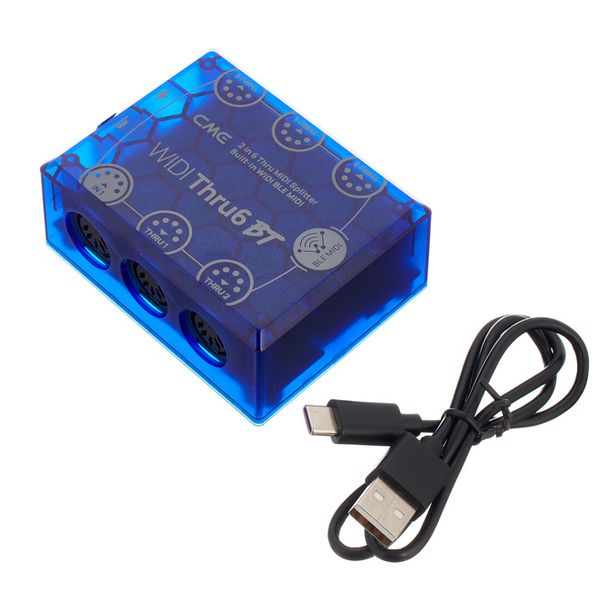


MIDI Splitter
- For loss-free transmission of all types of MIDI data to multiple receivers
- Bluetooth MIDI transmission possible
- Two Inputs and six Outputs
- Bluetooth range: Approx. 20 m
- System requirements: macOS Yosemite, iOS 8, Windows 10/11, Android 8
- USB bus-powered (5 V USB-C)
- Dimensions: 83.5 x 65 x 33.6 mm
- Weight: 96 g
Compatible with:
- WIDI Master
- WIDI Jack
- WIDI Uhost
- WIDI BudPro
- WIDI Core
- WIDI BUD
-
Available since June 2023
-
Item number 567854
-
Sales Unit 1 piece(s)
-
Wireless MIDI Yes
-
Midi Thru Yes
-
MIDI Merge No
-
MIDI Controller No
-
MIDI Converter / Interface No
-
MIDI Electronics No
Distribute MIDI data wirelessly
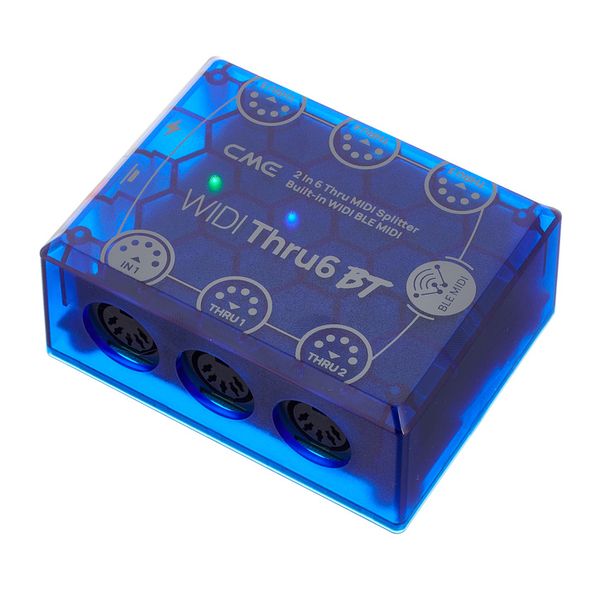
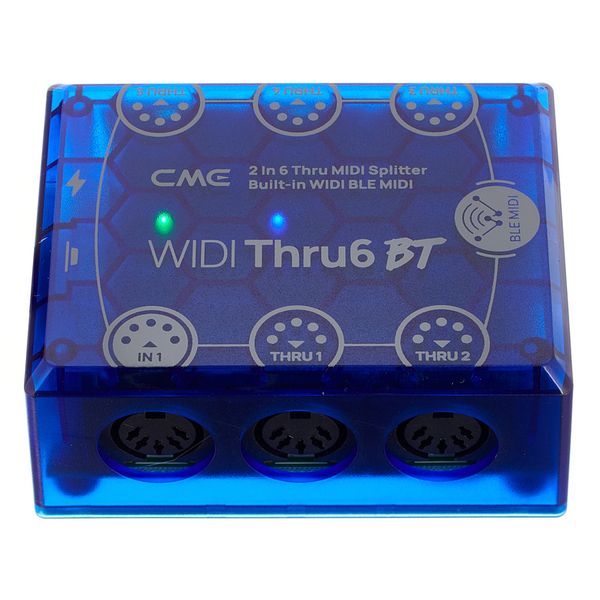
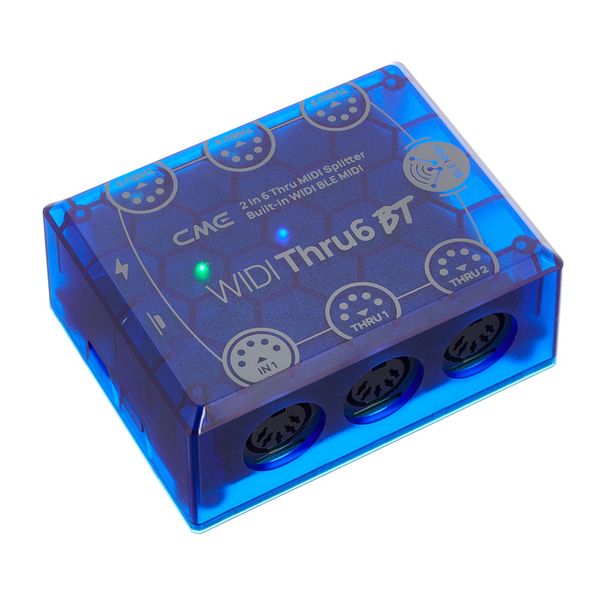
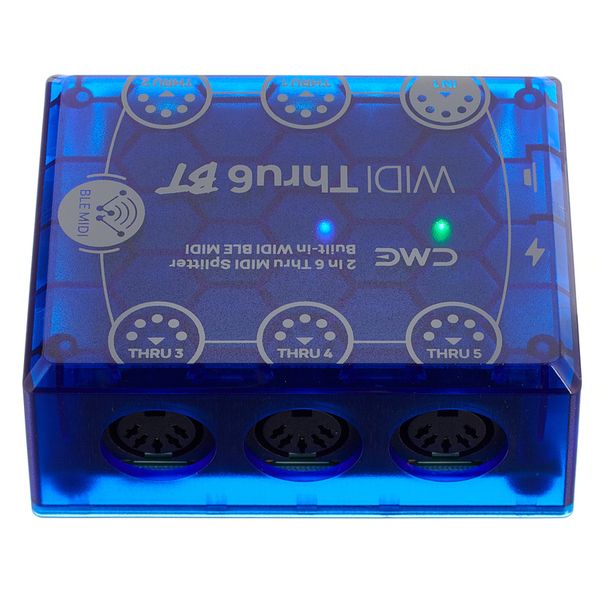
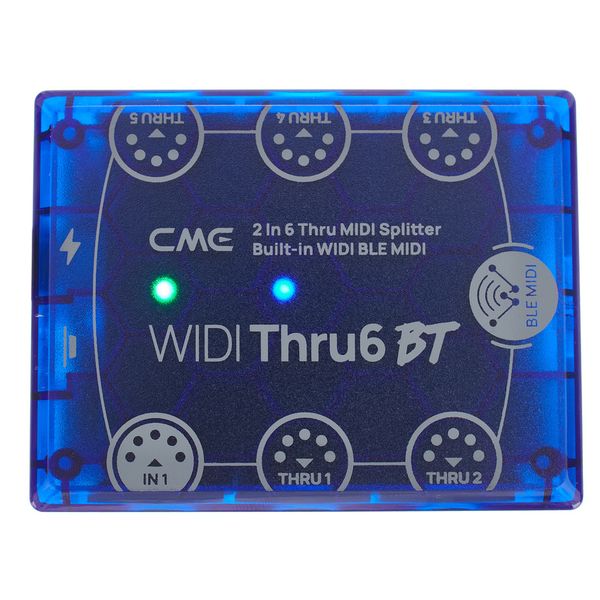
The CME WIDI Thru6 BT is a MIDI data distributor that supports both wired transmission and wireless transmission via Bluetooth: In addition to the Bluetooth interface, it features one wired input and five outputs. Its capable of realising its extremely low latency of just 3ms even over a wireless connection, and the 32-bit processor delivers four times the transmission speed of conventional MIDI transmitters. To ensure the seamless integration of all MIDI devices – and secure and error-free MIDI input – the WIDI Thru6 BT has a built-in optocoupler. The technical architecture is very well put together in general, guaranting the precise transmission of all MIDI commands, including Clock, SysEx, MTC and MPE. All in all, the WIDI Thru6 is a compact, modern, and reliable hub for combining and connecting a variety of musicmaking hardware.

)
Wired or wireless?
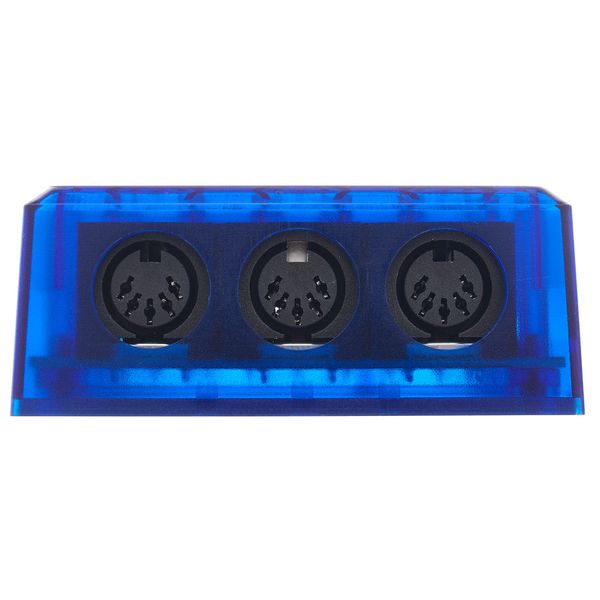
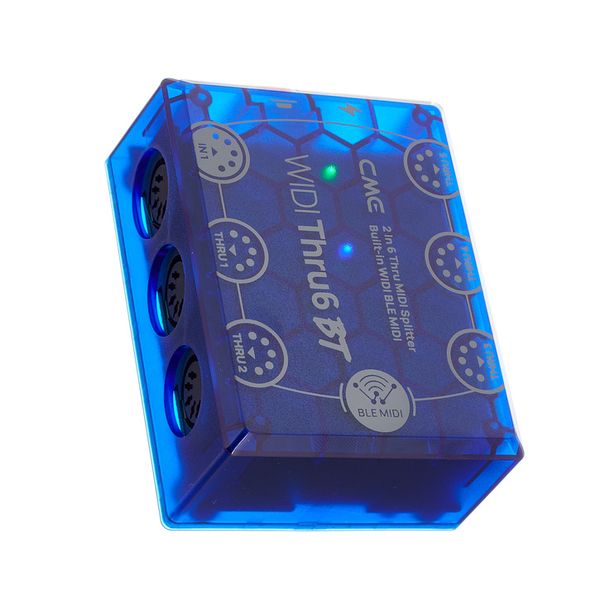
When this MIDI router is powered up via its USB-C socket, a green LED next to the connector lights up. On the front of the device is the MIDI input for receiving MIDI data from any connected hardware devices, with the second input coming in via Bluetooh 5.0 – capable of the bidirectional transmission of up to 16 channels. A blue LED lights up to confirm an active Bluetooth connection. Then, the five MIDI thru sockets can pass on this signal to any connected hardware devices.
)
Send and receive MIDI
The CME WIDI Thru6 BT is ideal for musicians who want to combine their hardware synths, samplers and keyboards in a complex setup, playing them via MIDI while also receiving and transmitting their MIDI data. To send and receive MIDI data over Bluetooth to hardware devices, the host must be running at least macOS Yosemite, iOS 8, Windows 10/11 or Android 8. And thanks to its flexible USB-C power supply, the CME WIDI Thru6 BT can be used in a wide range of scenarios: In addition to mains power (cable not included), it can also be run off a USB power bank, allowing this MIDI interface to be used on the fly in mobile setups.
)
About CME
CME is a Singapore-based innovator and an executive board member of the MIDI Association, developing smart MIDI tools shaped by community feedback. Focused on seamless workflows, the company creates both wireless and wired solutions for modern music makers. With its WIDI Bluetooth MIDI technology and iWA wireless audio initiatives, CME continues to expand what is possible in the hybrid world of audio and MIDI. Its tools — from wireless MIDI interfaces to smart USB solutions — are designed to operate invisibly in the background, allowing musicians to remain fully in their creative flow.
Daisy-chain your distribution network
To use the CME WIDI Thru6, it must first be powered via the USB-C socket. Beforehand, the hardware (synths, keyboards, samplers, etc.) should be connected to the distributor using 5-pin MIDI cables. If MIDI data is to be sent to more than five devices, a daisy-chain configuration can be set up with multiple units by connecting one of the MIDI Thru outputs to the MIDI input of the next CME WIDI Thru6: In this setup, a musician will probably also need a USB hub to provide power for the individual devices. This way, a daisy-chain made up of several CME WIDI Thru6 units can be used to for create complex setups, for endlessly flexible arrangements on stage or in the studio. To further simplify things, a Bluetooth connection can also be established directly between two CME WIDI Thru6 units.