


Arturia Pigments 7



Virtual Synthesizer (Download)
- Powerful and flexible synthesizer with various synthesis modes to choose from
- Two sound engines with variable sound sources
- Virtual analogue engine with triple oscillator
- Harmonic engine with up to 512 partials, phase modulation, and random control
- Wavetable engine with over 200 wavetables, ring modulation and adjustable pulse width
- Sample and granular engine
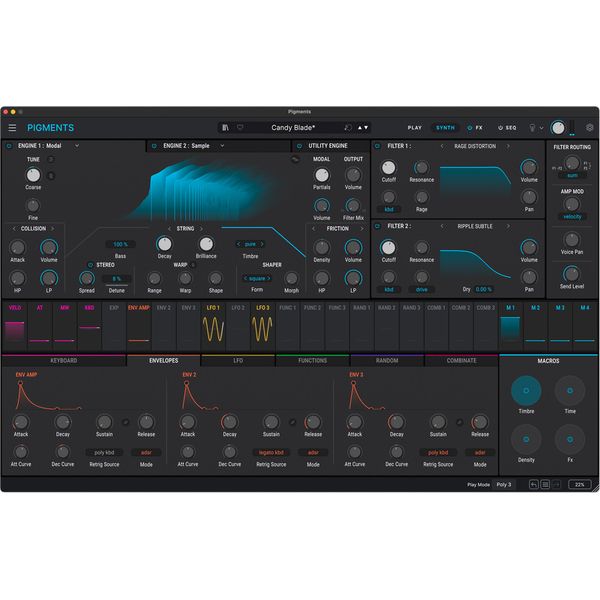
- Modal engine based on physical modelling and resonators
- Utility engine with sub-oscillator and two noise sample layers, as well as an input for external signals
- Unisono with adjustable number of voices, detuning, phase, and stereo width
- Dual filter engine with serial and parallel routing, 16 filter types and 59 filter modes
- Complex modulation matrix, flexible LFOs, and numerous sync options
- Supplemented by functions such as macro control and chord generation
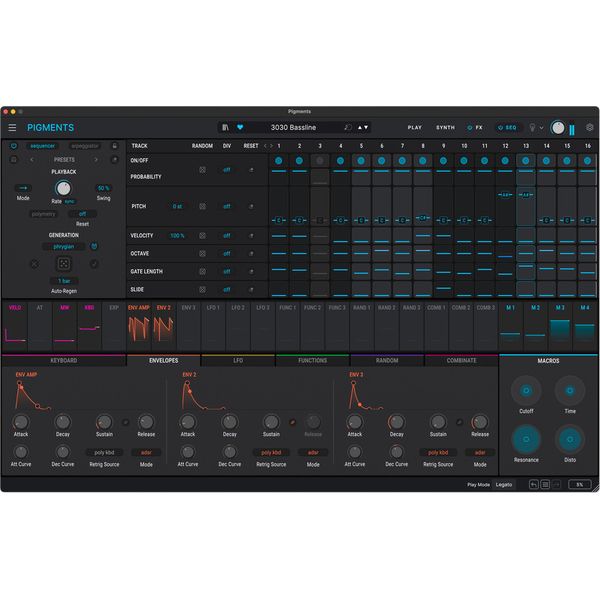
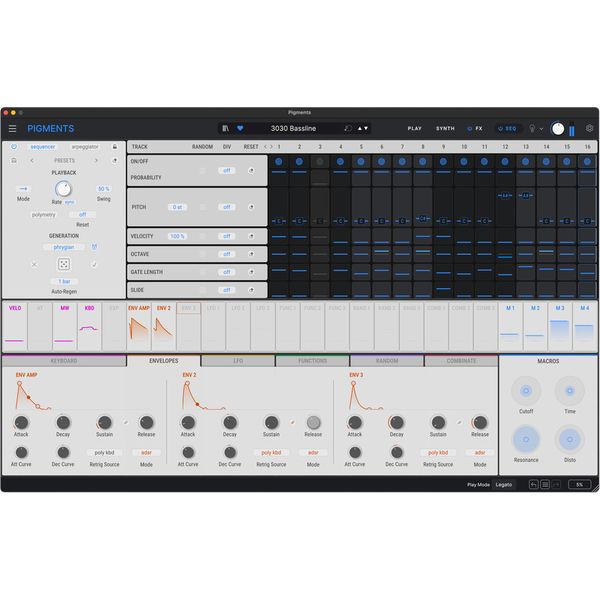
- Generative, polyrhythmic sequencer with storable presets and browser
- Polyrhythmic arpeggiator
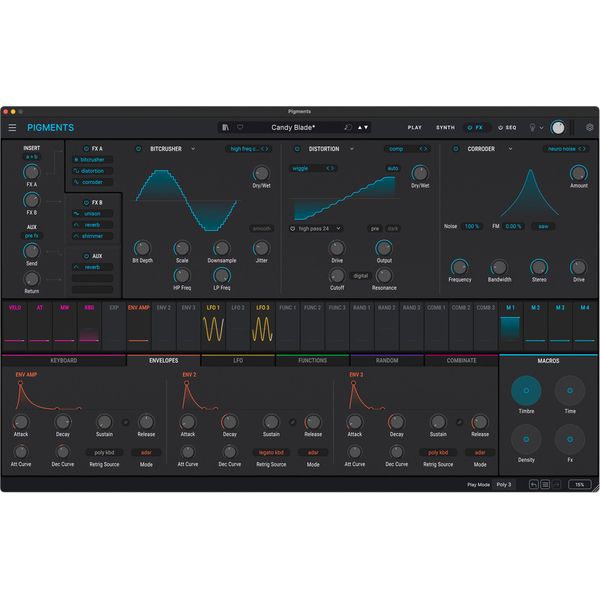
- Effects section with 20 different effects such as Shimmer Verb, Pitch-Shift Delay, BL-20 Flanger, Jun-6 Chorus, Vocoder, Corroder, etc.
- Library with over 1700 presets
- Compatible with ODDSound MTS-ESP Microtuning and MPE
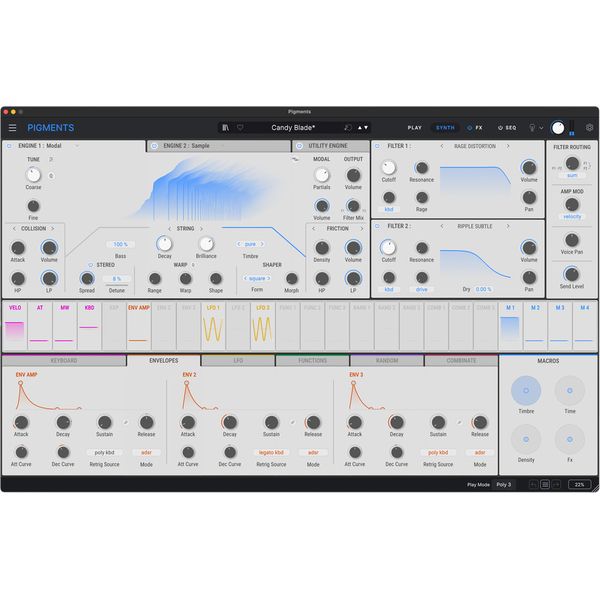
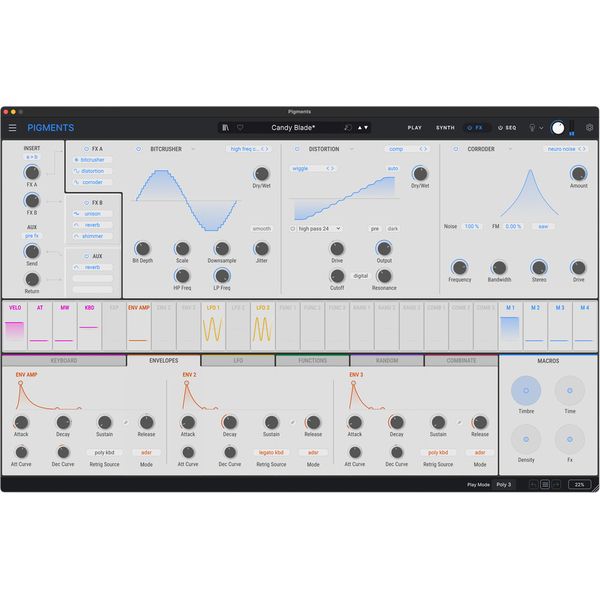
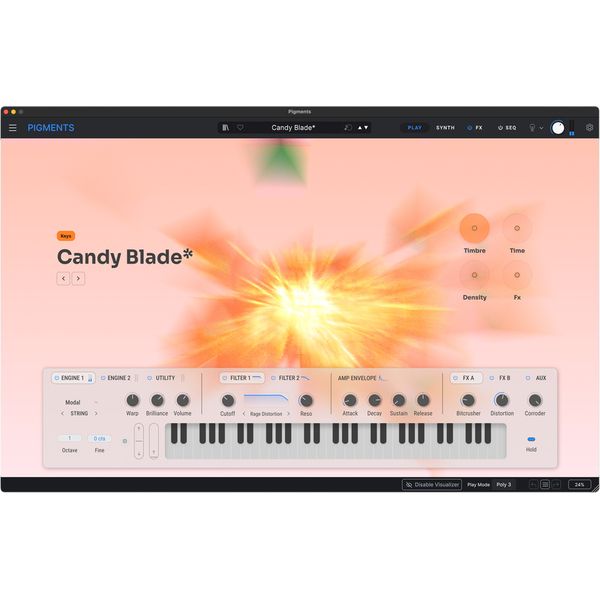
- Clear graphical user interface with light theme and play mode
- Version: 7
- Shipping Format: E-Mail
- License validity: perpetual
- Copy Protection: Arturia Software Center
- Simultaneous Activations: 5
- Windows: from 10 (64-Bit)
- Mac OS (64 Bit): from 10.13
- CPU min.: Quad Core 3,4 GHz
- CPU compatibility: Apple Intel, Apple Silicon, Windows AMD, Windows Intel
- RAM min.: 4 GB
- HD Storage min.: 2 GB
- add. System requirements: Internet Connection for Installation and Activation
- Stand-Alone-Software
- AAX native 64-Bit
- AU 64-Bit
- VST2 64-Bit
- VST3 64-Bit
- NKS
-
Available since December 2025
-
Item number 557039
-
Sales Unit 1 piece(s)
-
Single/Bundle article Los artikel
-
Akustik Keys/Pianos No
-
Beat production / Drum machines No
-
Wind Instruments No
-
Cinematic / Effects No
-
Chorus / Vocals No
-
Drums / Percussion No
-
E-Pianos No
-
Ethno / Folk No
-
Guitars/plucked instruments No
-
Loops/Construction-Kits No
-
Orchestra Instruments No
-
Organs No
-
String Bass No
-
Sampler No
-
String Instruments No
-
Synthesizer Yes
-
Vintage Instrument No
-
Hardware Controller No
-
Download Yes
-
MPE Yes
-
NKS Yes
-

A weapon of mass creation
Pigments 7, the latest evolution of Arturia's flagship software synthesizer, distils decades of synthesis expertise into a sleek, intuitive, and deeply capable instrument. It combines six sound engines – Virtual Analog, Wavetable, Granular, Harmonic, Modal, and Sample – within a visually engaging, colour-coded interface that streamlines sound design through drag-and-drop modulation and animated real-time feedback. Twin morphing filters, advanced modulation tools, and a generative sequencer further expand its sonic scope, while 20 premium effects and more than 1,700 presets span electronic, cinematic, ambient, and hybrid-acoustic production styles. For those who prefer exploration over deep programming, the audio-reactive Play View offers dynamic visualisations and immediate macro control, gradually revealing Pigments' full depth and workflow.

Six cutting-edge sound engines
At its core, Arturia's Pigments is built around a dual-engine architecture that allows users to combine any pair of its six primary synthesis engines – Modal, Granular, Wavetable, Sample, Harmonic, or Virtual Analog – while a third Utility engine provides additional oscillators, layered noise, and external audio processing options. Each engine has a distinct character: Modal delivers physically modelled strings and beams; Granular specialises in evolving textures and glitch-based atmospheres; Wavetable shapes razor-sharp leads and basses; Harmonic unlocks additive synthesis with up to 512 partials; Sample imports and manipulates custom audio; and Virtual Analog captures classic subtractive warmth. Twin morphing filters (19 types, 68 modes), three envelopes, three LFOs, advanced modulation routing, and 20 premium effects provide extensive shaping and movement.
)
Visual sound design
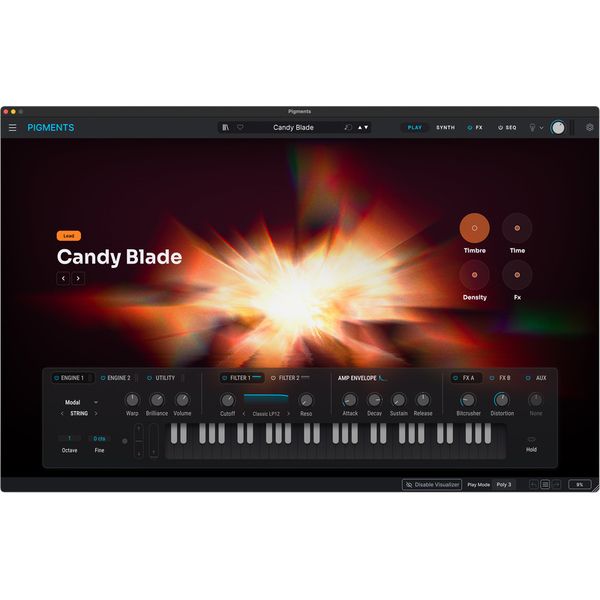
Pigments 7 makes deep sound design feel immediate. Its colour-coded layout clearly separates engines, filters, modulation, and effects, while drag-and-drop assignment keeps experimentation fluid. Modulation routings are animated in real time, and evolving wave-forms provide constant visual feedback, helping even complex patches remain transparent and manageable. The Play View shifts focus from architecture to performance, offering streamlined macro control and immersive visuals. The animated graphics reflect which engines, filters, and modulators are active, offering visual insight into how each layer contributes to the overall sound. Meanwhile, the sequencer transforms static tones into animated patterns, encouraging movement and variation without breaking creative flow. The result is a synthesizer that encourages exploration rather than overwhelming the user with complexity.
)
About Arturia
Arturia's success story began with software emulations of well-known analogue synthesizers such as the Moog Minimoog, Sequential Prophet-5, and Oberheim SEM. The popular software instruments included in the V Collection are still flagship products of the French developer today. Over time, Arturia has gradually expanded its range and now also offers a host of hardware devices, ranging from synthesizers and keyboard controllers to sequencers. Since then, the former software developer has thus also become a household name in the world of analogue synthesizers and other equipment.
A modern flagship synthesizer
With over 1,700 presets, expanded wavetables and samples, and a continuously growing sound library, Pigments balances immediate inspiration with near-limitless depth. Beginners can start experimenting with polished sounds straight away, while advanced users can dive into additive partial sculpting, physical modelling, external audio processing, and layered engine combinations in meticulous detail. Crucially, Pigments feels forward-looking rather than nostalgic; its aesthetic is unapologetically modern, suited to electronic, cinematic, experimental, and hybrid production alike. Extensive online tutorials and guided resources make the learning curve approachable, while ongoing free updates reinforce its long-term value. As part of Arturia's wider ecosystem, Pigments integrates seamlessly alongside instruments such as PolyBrute and also forms a forward-facing cornerstone of the V Collection, while remaining fully capable as a standalone instrument. Rather than recreating the past, it stands as a complete platform for producers shaping tomorrow's music.
In the spotlight
Whats new in Version 7
Arturia's Pigments has matured through successive updates, steadily expanding its sonic vocabulary. The introduction of the Modal engine brought physical modelling into the fold, while granular scanning, expanded filter models, and creative tools like the Vocoder and Voice Modulator deepened its experimental reach. Version 7 refines this foundation with an enhanced Play Page for a more immersive performance experience, new Rage, Ripple, and Reverb filters for more aggressive or textural tone sculpting, and the Corroder effect for added grit and character. Workflow improvements – from clearer modulation visualisation to refined envelope behaviour, CPU optimisation, and enhanced MPE responsiveness – ensure all patches remain stable, expressive, and performance-ready. This is evolution with intent, not feature bloat.
)
