


T
Great practice tool (...maybe for recording, too?)
I bought this for practicing electric bass guitar, and it's perfect for that.
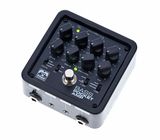
The size and layout of the device are very good: you get a lot of functionality and connectivity in something you can comfortably hold in one hand. The description "pocket" is a bit misleading, I think - maybe other people have bigger pockets than me(?) - but if it was any smaller then the controls would be too close together, and fiddly to adjust.
It seems well made, and pretty road-worthy. But I'm not planning on gigging with it - it will stay at home.
The sound is really good. Of the three MODES, I prefer O.DRIVE, which can add a nice degree of musical saturation. Of the three CAB voicings, I prefer MODERN (which adds low frequency "weight") or VINTAGE (which adds mid range "throatiness"). The "Saturate" control is mis-labeled, in my opinion; I would have called it "Compression", which it does really well; it's actually one of the most musical "one-knob compressors" I've ever used on bass. There's lots of output volume available (if anything slightly too much; I have to adjust the Vol knob quite carefully not to deafen myself).
I've given it four stars instead of five for "sound" because it's not the quietest device I've ever used. The noise level is still pretty good...but there's definitely a slight layer of background hiss, more than other bass gear I own (e.g. a mark II SansAmp). For practicing this doesn't matter; I never notice it. But it's a pity, because if it wasn't for the noise I think it would be great for recording, too. I'll try it at some point; maybe in a mix the noise won't matter(?)
As an "all-in-one bass practice tool" it's missing a few things, perhaps:
* a tuner
* metronome
* a volume control for the aux input
...but I don't need them: I've got tuners already, you can get metronome apps for your phone, and pretty much anything you connect to it will have its own volume control anyway. Adding those things would have increased the price, and the size of the device.
One final thing: either I'm practising more than I used to - a good sign! - or it eats batteries like sweets. So do the planet a favour, and get a mains adapter or some rechargeable batteries :)
The size and layout of the device are very good: you get a lot of functionality and connectivity in something you can comfortably hold in one hand. The description "pocket" is a bit misleading, I think - maybe other people have bigger pockets than me(?) - but if it was any smaller then the controls would be too close together, and fiddly to adjust.
It seems well made, and pretty road-worthy. But I'm not planning on gigging with it - it will stay at home.
The sound is really good. Of the three MODES, I prefer O.DRIVE, which can add a nice degree of musical saturation. Of the three CAB voicings, I prefer MODERN (which adds low frequency "weight") or VINTAGE (which adds mid range "throatiness"). The "Saturate" control is mis-labeled, in my opinion; I would have called it "Compression", which it does really well; it's actually one of the most musical "one-knob compressors" I've ever used on bass. There's lots of output volume available (if anything slightly too much; I have to adjust the Vol knob quite carefully not to deafen myself).
I've given it four stars instead of five for "sound" because it's not the quietest device I've ever used. The noise level is still pretty good...but there's definitely a slight layer of background hiss, more than other bass gear I own (e.g. a mark II SansAmp). For practicing this doesn't matter; I never notice it. But it's a pity, because if it wasn't for the noise I think it would be great for recording, too. I'll try it at some point; maybe in a mix the noise won't matter(?)
As an "all-in-one bass practice tool" it's missing a few things, perhaps:
* a tuner
* metronome
* a volume control for the aux input
...but I don't need them: I've got tuners already, you can get metronome apps for your phone, and pretty much anything you connect to it will have its own volume control anyway. Adding those things would have increased the price, and the size of the device.
One final thing: either I'm practising more than I used to - a good sign! - or it eats batteries like sweets. So do the planet a favour, and get a mains adapter or some rechargeable batteries :)
17
1
Report
Jo
Amazing clean channel and packed with features
I bought it mainly because of the headphone output and the “sweepable” middle frequencies and I am not dissapointed!
The clean channel sounds amazing with both my active and passive basses. The controls are super responsive and give you a lot of possibilities, and the knobs feels sturdy. The FX insert is a great idea to save space and the other features like speaker emulation and headphones output sound really good.
I deducted points because the Overdrive and Fuzz channels are too mild in my opinion. In order to get a good crunchy sound out of them, you need to crank the Drive almost all the way up (I go all the way!) and use the Normal input (not the -12dB) even if your bass is active. It only really crunches when the input signal peaks. Otherwise, it would be the ultimate affordable portable amp. In those conditions, it's a really good fuzz pedal, too!
On the other hand, with the OD and Fuzz you can use the Blend at 100% wet signal and still won't lose a lot of bottom end, which is a nice plus - as is the auxiliary input, for practicing.
The manual could be much better. For example, I am still not quite sure I understand what exactly the Saturate knob does - mostly, I just go as high as right before my tone starts to sound funny, for the compression. All in all, it takes some work to master all the dials.
I still haven't, but I would easily use it for recording of on stage (the option to use the DI pre or post EQ is also a great feature!). The metal housing and the foot switch feel they can take some stomping.
The other day I used it to practice guitar with headphones (7-stringer with a heavy distortion pedal) and it sounded pretty good, too! =D
The clean channel sounds amazing with both my active and passive basses. The controls are super responsive and give you a lot of possibilities, and the knobs feels sturdy. The FX insert is a great idea to save space and the other features like speaker emulation and headphones output sound really good.
I deducted points because the Overdrive and Fuzz channels are too mild in my opinion. In order to get a good crunchy sound out of them, you need to crank the Drive almost all the way up (I go all the way!) and use the Normal input (not the -12dB) even if your bass is active. It only really crunches when the input signal peaks. Otherwise, it would be the ultimate affordable portable amp. In those conditions, it's a really good fuzz pedal, too!
On the other hand, with the OD and Fuzz you can use the Blend at 100% wet signal and still won't lose a lot of bottom end, which is a nice plus - as is the auxiliary input, for practicing.
The manual could be much better. For example, I am still not quite sure I understand what exactly the Saturate knob does - mostly, I just go as high as right before my tone starts to sound funny, for the compression. All in all, it takes some work to master all the dials.
I still haven't, but I would easily use it for recording of on stage (the option to use the DI pre or post EQ is also a great feature!). The metal housing and the foot switch feel they can take some stomping.
The other day I used it to practice guitar with headphones (7-stringer with a heavy distortion pedal) and it sounded pretty good, too! =D
4
0
Report
N
Compact and Versatile - A Valuable Tool for any Bassist
This is a compact, versatile DI preamp pedal serving many use cases relevant to bass practice and performing. Offerings from other brands such as Darkglass, Ampeg, Sansamp etc. may be more enticing with specific house sound and proprietary features, but they’re also costly, whereas the Palmer is a cost-effective, somewhat neutral and reliable swiss-army-knife of a pedal.
Besides being a mains-powered, active DI preamp box for a pedal board or amp/combo amp, it’s also a handy battery-powered portable headphone amp for practicing on the go or in silence. With numerous outputs, it functions as a buffered signal splitter for live and recording scenarios.
Pros:
- Portable and sturdy.
- Good EQ/preamp, sweepable Mid-frequency knob covering huge range.
- I/O for signal splitting.
- Headphone out for practice.
Cons:
- Documentation could be more thorough.
- Ports are precisely machined but not smooth to plug in.
- Pops when plugging/unplugging jacks.
- Aux-in volume is controlled entirely by source.
- No USB-out for use as an interface, nor bluetooth capabilities for wireless headphones or aux-in audio.
Notes:
- Signal level of the DI XLR Out, ¼" TRS Out, and the Thru Out, are all different. DI XLR Out: +4DBU and 510 Ohm, ¼” TRS Out: 0DBV and 10k Ohm; Thru Out’s specs not specified but I’m guessing they are equal to the instrument itself plus length of cable. Signal level of the DI XLR Out and ¼” TRS Out are attenuated by the Volume knob.
- ¼” TRS Out is electrically isolated from DI XLR Out and parallel; note that it isn't affected by the pre-/post- switch that controls whether the DI XLR Out carries the signal from before or after the pedal’s circuitry. Hence the ¼” TRS Out will always carry the post- signal modified by EQ/overdrive/cab sim.
- Thru Out is unaffected by the pedal’s circuitry and always active, useful for a tuner pedal or for sending a clean unprocessed signal to another amp or interface. As it is true unbuffered bypass the quality may sound, accordingly, sterile and thin and much lower in volume. Myself having a bass with passive pickups sensitive to load, I placed the Korg Pitchblack XS Bass tuner right after the bass and before the Palmer; accordingly with this buffer in place, the tone out of the Palmer’s Thru was deep and bright.
- FX-Loop is a single port requiring an uncommon Y-cable with both the send and return - inconvenient but economical use of space. Better documentation of the internal signal chain would have helped understanding where the FX loop lies, for deciding what pedals would be best suited being inside the loop as opposed to adjacent to the Palmer.
- Footswitch’s mode selector lets you either bypass the pedal, or mute the signal going out of DI XLR or ¼” TRS Out. Bypass sounds great to my ear, identical to the processed signal; probably buffered.
- Aside from the LED for mute/bypassed, a second LED glows green to indicate nominal level, amber for proximity to clipping, and red for clipping. Pad switch comes in handy to attenuate the input by -12dB.
- 3-band EQ knobs, each having both cut and boost capability, comprise a solid preamp section. Mid knob has an accompanying frequency sweeper which lets you specify exactly which Mid frequency you would like to attenuate. The remarkably wide frequency range of the sweeper going from as low as 150Hz all the way up to 8kHz seems to be somewhat unusual and makes it useful not just for bass but for guitar too. This definitely sets the Palmer apart from any of the other DI preamp pedals out there.
- Headphones Out signal is stereo. Output impedance of the port is not documented but it is able to drive both my high-impedance Sennheiser HD 6XX and low-impedance Koss Porta Pros transparently with ease.
- No controls for Aux-in, so take care to control the volume from the input device.
- No measures taken in the circuitry to minimize pops from connecting/disconnecting plugs, a rare oversight in the design and implementation. As a result, these pops can be very loud and potentially damaging for connected devices.
- Overdrive and Fuzz are nice to have if unremarkable. Aside from portable convenience, they work well with the Drive and Saturation knobs. On both bass and guitar, I like the overdrive only lightly driven, giving some dirt and midrange warmth helping to accentuate the growl from my soloed bridge pickups. Fuzz is somewhat sensitive to the power; hence sometimes when battery-powered it’s weak and intermittent, whereas when mains-powered it’s much more full-sounding and reliable.
- Saturation is one of the less documented and understood features of the Palmer with a tape saturation effect most noticeable used with overdrive and fuzz, plus possibly some limiter functionality.
- Alongside the standard Flat setting, “Vintage” and “Modern” amp sims are somewhat understated but useful even if you have other equipment fulfilling the same purpose. Compared to my Boss combo amp’s sim, the Palmer’s Modern is more desirable sometimes with its more dusky and less shimmery presentation.
- Sims add character to the Palmer which may have otherwise not been felt, being mostly a preamp pedal from a brand known for its clean power utilities and transparent DI boxes as opposed to effects pedals, hence lacking a specific house sound other pedals may have. I did reach out directly to Adam Hall, owners of the Palmer brand, inquiring about the internals and whether it shared any tech with the other DI boxes in its catalog. The reply, while prompt and gracious, was lacking in specifics.
- Power supply must be purchased separately. Ground Lift is handy to eliminate ground loops; as always treat that with care when connecting numerous instruments. The Boss PSA 230S is adequate for sufficient, noiseless power; even when powering both the Korg Pitchblack and the Palmer in daisy chain, it remained noiseless with performance unaffected.
Besides being a mains-powered, active DI preamp box for a pedal board or amp/combo amp, it’s also a handy battery-powered portable headphone amp for practicing on the go or in silence. With numerous outputs, it functions as a buffered signal splitter for live and recording scenarios.
Pros:
- Portable and sturdy.
- Good EQ/preamp, sweepable Mid-frequency knob covering huge range.
- I/O for signal splitting.
- Headphone out for practice.
Cons:
- Documentation could be more thorough.
- Ports are precisely machined but not smooth to plug in.
- Pops when plugging/unplugging jacks.
- Aux-in volume is controlled entirely by source.
- No USB-out for use as an interface, nor bluetooth capabilities for wireless headphones or aux-in audio.
Notes:
- Signal level of the DI XLR Out, ¼" TRS Out, and the Thru Out, are all different. DI XLR Out: +4DBU and 510 Ohm, ¼” TRS Out: 0DBV and 10k Ohm; Thru Out’s specs not specified but I’m guessing they are equal to the instrument itself plus length of cable. Signal level of the DI XLR Out and ¼” TRS Out are attenuated by the Volume knob.
- ¼” TRS Out is electrically isolated from DI XLR Out and parallel; note that it isn't affected by the pre-/post- switch that controls whether the DI XLR Out carries the signal from before or after the pedal’s circuitry. Hence the ¼” TRS Out will always carry the post- signal modified by EQ/overdrive/cab sim.
- Thru Out is unaffected by the pedal’s circuitry and always active, useful for a tuner pedal or for sending a clean unprocessed signal to another amp or interface. As it is true unbuffered bypass the quality may sound, accordingly, sterile and thin and much lower in volume. Myself having a bass with passive pickups sensitive to load, I placed the Korg Pitchblack XS Bass tuner right after the bass and before the Palmer; accordingly with this buffer in place, the tone out of the Palmer’s Thru was deep and bright.
- FX-Loop is a single port requiring an uncommon Y-cable with both the send and return - inconvenient but economical use of space. Better documentation of the internal signal chain would have helped understanding where the FX loop lies, for deciding what pedals would be best suited being inside the loop as opposed to adjacent to the Palmer.
- Footswitch’s mode selector lets you either bypass the pedal, or mute the signal going out of DI XLR or ¼” TRS Out. Bypass sounds great to my ear, identical to the processed signal; probably buffered.
- Aside from the LED for mute/bypassed, a second LED glows green to indicate nominal level, amber for proximity to clipping, and red for clipping. Pad switch comes in handy to attenuate the input by -12dB.
- 3-band EQ knobs, each having both cut and boost capability, comprise a solid preamp section. Mid knob has an accompanying frequency sweeper which lets you specify exactly which Mid frequency you would like to attenuate. The remarkably wide frequency range of the sweeper going from as low as 150Hz all the way up to 8kHz seems to be somewhat unusual and makes it useful not just for bass but for guitar too. This definitely sets the Palmer apart from any of the other DI preamp pedals out there.
- Headphones Out signal is stereo. Output impedance of the port is not documented but it is able to drive both my high-impedance Sennheiser HD 6XX and low-impedance Koss Porta Pros transparently with ease.
- No controls for Aux-in, so take care to control the volume from the input device.
- No measures taken in the circuitry to minimize pops from connecting/disconnecting plugs, a rare oversight in the design and implementation. As a result, these pops can be very loud and potentially damaging for connected devices.
- Overdrive and Fuzz are nice to have if unremarkable. Aside from portable convenience, they work well with the Drive and Saturation knobs. On both bass and guitar, I like the overdrive only lightly driven, giving some dirt and midrange warmth helping to accentuate the growl from my soloed bridge pickups. Fuzz is somewhat sensitive to the power; hence sometimes when battery-powered it’s weak and intermittent, whereas when mains-powered it’s much more full-sounding and reliable.
- Saturation is one of the less documented and understood features of the Palmer with a tape saturation effect most noticeable used with overdrive and fuzz, plus possibly some limiter functionality.
- Alongside the standard Flat setting, “Vintage” and “Modern” amp sims are somewhat understated but useful even if you have other equipment fulfilling the same purpose. Compared to my Boss combo amp’s sim, the Palmer’s Modern is more desirable sometimes with its more dusky and less shimmery presentation.
- Sims add character to the Palmer which may have otherwise not been felt, being mostly a preamp pedal from a brand known for its clean power utilities and transparent DI boxes as opposed to effects pedals, hence lacking a specific house sound other pedals may have. I did reach out directly to Adam Hall, owners of the Palmer brand, inquiring about the internals and whether it shared any tech with the other DI boxes in its catalog. The reply, while prompt and gracious, was lacking in specifics.
- Power supply must be purchased separately. Ground Lift is handy to eliminate ground loops; as always treat that with care when connecting numerous instruments. The Boss PSA 230S is adequate for sufficient, noiseless power; even when powering both the Korg Pitchblack and the Palmer in daisy chain, it remained noiseless with performance unaffected.
0
0
Report
A
Pocket Amp
So it's rather cheap, has lots of controls and inputs and outputs. And it's tiny. I like that I can take it wherever I take my bass, just plug into it and play.
- Bypass is not really a bypass, it's amplifying the signal, too. It creates nice clean full tone. Sounds better than plugging the bass directly into the Hi-Z input of a mixer;
- EQ controls affect the overdriven sound. If you set Blend to 0, EQ will be flat;
- Gain+Blend+EQ controls make for lots of combinations of settings. I find it rather difficult to set a good tone. Sometimes the best tone I can get is the Bypass (Green LED);
- I can't really hear what Saturation does. According to the manual, it's a mild compression.
- Aux in and headphone out are great for practice in the night;
All in all, it's a great combination of features.
I guess if you pay more and buy a bigger box, you'll get better tone. But you won't be able to carry it in your pocket.
- Bypass is not really a bypass, it's amplifying the signal, too. It creates nice clean full tone. Sounds better than plugging the bass directly into the Hi-Z input of a mixer;
- EQ controls affect the overdriven sound. If you set Blend to 0, EQ will be flat;
- Gain+Blend+EQ controls make for lots of combinations of settings. I find it rather difficult to set a good tone. Sometimes the best tone I can get is the Bypass (Green LED);
- I can't really hear what Saturation does. According to the manual, it's a mild compression.
- Aux in and headphone out are great for practice in the night;
All in all, it's a great combination of features.
I guess if you pay more and buy a bigger box, you'll get better tone. But you won't be able to carry it in your pocket.
6
0
Report
p
Play bass on a beach!
You probably stumbled on this product page out of curiosity, because you had never heard of Palmer before. Neither did I! You might also be wondering if you'd be better off paying more for an Aguilar or ToneX product. Maybe?
The thing I love about the Palmer is that it's a very straightforward plug-and-play product, delivered in a very attractive little package. It's a joy to use, and you don't have to pair it to your phone, fiddle in some bloated software suite, or watch a bunch of YouTube videos to get it sounding good. I don't know about you, but having less screen time is great, and it leaves more time to, you know, play music!
The Palmer sounds pretty good. Sure, you could get better sound out of an Aguilar Tone Hammer, but at twice the cost. Meanwhile, these cheap little Korg/Vox amplugs don't come anywhere close to what you get here. Palmer gives you a loud, full bodied bass sound, with some pleasing characteristics. I wouldn't use it for live performances, but it's more than enough for quiet practice at home or on the road.
The build quality is quite good. The knobs feel good. The effects are fine. Fuzz sounds fuzzy and distortion sounds distorted. It can be battery-powered, and one 9V battery will last you a while. The compressor and cab settings don't affect the sound as much as you'd expect, but they don't really matter that much. You can also plug in an audio device via the auxiliary port, to play along to Spotify or YouTube.
Should you buy this over a ToneX product? It depends on your budget and what you're looking for. As a practice headphone amp, the Palmer bass amp is very much feature-complete, and delivers good results. Also, unlike the ToneX One (which I do like very much), you don't have to spend hours configuring it before it's good to go!
The thing I love about the Palmer is that it's a very straightforward plug-and-play product, delivered in a very attractive little package. It's a joy to use, and you don't have to pair it to your phone, fiddle in some bloated software suite, or watch a bunch of YouTube videos to get it sounding good. I don't know about you, but having less screen time is great, and it leaves more time to, you know, play music!
The Palmer sounds pretty good. Sure, you could get better sound out of an Aguilar Tone Hammer, but at twice the cost. Meanwhile, these cheap little Korg/Vox amplugs don't come anywhere close to what you get here. Palmer gives you a loud, full bodied bass sound, with some pleasing characteristics. I wouldn't use it for live performances, but it's more than enough for quiet practice at home or on the road.
The build quality is quite good. The knobs feel good. The effects are fine. Fuzz sounds fuzzy and distortion sounds distorted. It can be battery-powered, and one 9V battery will last you a while. The compressor and cab settings don't affect the sound as much as you'd expect, but they don't really matter that much. You can also plug in an audio device via the auxiliary port, to play along to Spotify or YouTube.
Should you buy this over a ToneX product? It depends on your budget and what you're looking for. As a practice headphone amp, the Palmer bass amp is very much feature-complete, and delivers good results. Also, unlike the ToneX One (which I do like very much), you don't have to spend hours configuring it before it's good to go!
2
0
Report
d
SansAmp on budget
I've never heard about Palmer before. They made pretty impressive little bass machine!
Here are my observations after few tests:
- pretty solid build, but has some flaws in coating. That makes it look "cheaper", than it could be.
- impressive EQ with parametric mids. A lot of options to shape your tone.
- can be used as DI-box.
- can be used as practice amp with headphones.
- can be used as overdrive/fuzz effect.
- Blend control is useful to create mix of dry and overdirven signal. I find this the most cool feature of the device.
- thus, it gives a lot of routing possibilities.
- overall tone is pretty good, though not the best one maybe.
- can be powered with 9V battery, which is useful if you don't have standalone power source.
Conclusion: very good device for it's money! It gives you DI-box, overdrive/fuzz effect, practice amp and splitter in a single unit. Good choice, as for me.
Here are my observations after few tests:
- pretty solid build, but has some flaws in coating. That makes it look "cheaper", than it could be.
- impressive EQ with parametric mids. A lot of options to shape your tone.
- can be used as DI-box.
- can be used as practice amp with headphones.
- can be used as overdrive/fuzz effect.
- Blend control is useful to create mix of dry and overdirven signal. I find this the most cool feature of the device.
- thus, it gives a lot of routing possibilities.
- overall tone is pretty good, though not the best one maybe.
- can be powered with 9V battery, which is useful if you don't have standalone power source.
Conclusion: very good device for it's money! It gives you DI-box, overdrive/fuzz effect, practice amp and splitter in a single unit. Good choice, as for me.
6
0
Report
A
I bought the Palmer Pocket Amp Bass because it looked promising and has a headphone output -- handy for practising at home. I have been delighted to find that the Palmer offers a much greater range of sounds than my Mk1 Sansamp Bass Driver DI.
The Palmer Pocket Amp Bass sound shaping is flexible, and tube emulation is excellent, including a whole spectrum of appealing overdrive distortion. I already own a couple of tube amps (an Ashdown and a Warwick with a tube preamp), so I'm familiar with the real thing.
I own about 15 bass guitars, fretted and fretless, 4 and 5 string, some passive but mainly active, including several graphite necked headless basses from the 1980s and 90s and some boutique luthier made basses. The Palmer is effective at letting their character show through, and adjusting it in interesting ways. Plus of course, practising without waking up the neighbours -- the main reason I bought it. Recommended.
The Palmer Pocket Amp Bass sound shaping is flexible, and tube emulation is excellent, including a whole spectrum of appealing overdrive distortion. I already own a couple of tube amps (an Ashdown and a Warwick with a tube preamp), so I'm familiar with the real thing.
I own about 15 bass guitars, fretted and fretless, 4 and 5 string, some passive but mainly active, including several graphite necked headless basses from the 1980s and 90s and some boutique luthier made basses. The Palmer is effective at letting their character show through, and adjusting it in interesting ways. Plus of course, practising without waking up the neighbours -- the main reason I bought it. Recommended.
16
1
Report
S
a hidden gem for heavy tones
I play bass in a doom/stoner setup and run a pretty involved pedal chain — from compression and octave pedals up to multiple dirt boxes (Jackhammer, modded DS-1, Deluxe Bass Big Muff, etc.). The Palmer Pocket Amp Bass sits at the end of my chain and ties everything together beautifully.
What really stands out is how it makes the whole rig sound unified and massive, whether going direct or into a power amp. The EQ section is musical and responsive — the mids actually do something useful, which is rare in compact units. The cab sim options are subtle but effective; the “Modern” setting adds just the right amount of edge for fuzz and overdrive-heavy tones.
I also love how it reacts to pedals in front — fuzz stays thick and alive, not fizzy or scooped. It smooths out aggressive signals without killing the character of each pedal. The “Drive” control itself can push into a warm, vintage grind that complements doom bass perfectly, especially with a Precision Bass and flatwounds.
It’s built like a tank, dead quiet even with lots of gain, and small enough to throw in a gig bag. For anyone running a complex pedalboard or needing a reliable DI/preamp that doesn’t color your tone in a bad way — this thing is an absolute sleeper.
What really stands out is how it makes the whole rig sound unified and massive, whether going direct or into a power amp. The EQ section is musical and responsive — the mids actually do something useful, which is rare in compact units. The cab sim options are subtle but effective; the “Modern” setting adds just the right amount of edge for fuzz and overdrive-heavy tones.
I also love how it reacts to pedals in front — fuzz stays thick and alive, not fizzy or scooped. It smooths out aggressive signals without killing the character of each pedal. The “Drive” control itself can push into a warm, vintage grind that complements doom bass perfectly, especially with a Precision Bass and flatwounds.
It’s built like a tank, dead quiet even with lots of gain, and small enough to throw in a gig bag. For anyone running a complex pedalboard or needing a reliable DI/preamp that doesn’t color your tone in a bad way — this thing is an absolute sleeper.
1
0
Report
C
Sounds great but fiddly
The sound from this preamp is fantastic. The semi parametric EQ allows me to dial in the tone I'm seeking. It makes even a cheap bass sound boutique!
The only thing I don't like is its hard to setup. The instructions are minimum and it took a long time to find "my sound". But I found I had to tweak it even further when switching to the distorted sound, so I couldn't simply switch sounds on the fly. I would require a seperate distortion/fuzz for that.
If you want a set and forget preamp with DI out, and have patience to play around with the settings to find your own sound, then this is the pedal for you.
The only thing I don't like is its hard to setup. The instructions are minimum and it took a long time to find "my sound". But I found I had to tweak it even further when switching to the distorted sound, so I couldn't simply switch sounds on the fly. I would require a seperate distortion/fuzz for that.
If you want a set and forget preamp with DI out, and have patience to play around with the settings to find your own sound, then this is the pedal for you.
6
0
Report
I
confused
so its a little bit confusing for me .
first, my pedal is active when the light is red and inactive when green , feels a bit counterintuitive unless my pedal is faulty.
build quality is not great, i had shorting specially with the gain so sometimes i need to actually push it to make it work.
due to its small size, the knobs are very close to each other which is annoying but a compromise that i accept.
you cannot change between clean , fuzz and distortion on the fly due to the difference in levels that creates.
for the pros, i mainly use the clean sound and it gives a lot of tonal variation. i love the blend knob which makes everything more organic to my ears. it has 2 cab sims that do a decent job , i usually use the modern and it sounds very good. lastly , you get a fair amount of in and outs for practicing, recording or playing alone.
first, my pedal is active when the light is red and inactive when green , feels a bit counterintuitive unless my pedal is faulty.
build quality is not great, i had shorting specially with the gain so sometimes i need to actually push it to make it work.
due to its small size, the knobs are very close to each other which is annoying but a compromise that i accept.
you cannot change between clean , fuzz and distortion on the fly due to the difference in levels that creates.
for the pros, i mainly use the clean sound and it gives a lot of tonal variation. i love the blend knob which makes everything more organic to my ears. it has 2 cab sims that do a decent job , i usually use the modern and it sounds very good. lastly , you get a fair amount of in and outs for practicing, recording or playing alone.
3
0
Report