


Arturia AudioFuse Studio B-Stock

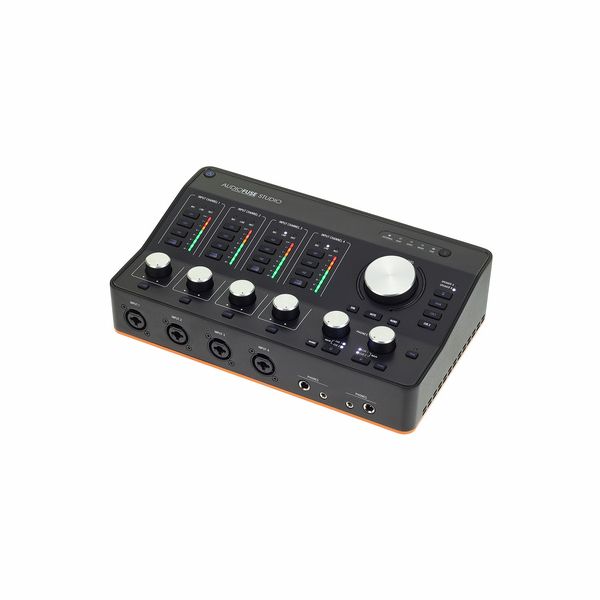
USB 2.0 Audio Interface
- 24-Bit / 192 kHz
- 18 inputs and 20 outputs
- 4 mic / line inputs: XLR / TRS combo socket
- 4 line inputs: 6.3 mm TRS
- Phono input: Cinch
- Inputs: 1 - 4 switchable for instruments
- Inserts for inputs: 1 - 4: 6.3 mm TRS
- 4 line outputs: 6.3 mm TRS
- 2 AUX outputs: 6.3 mm TRS for line signals and reamping
- S/PDIF coaxial input and output: Cinch
- Switchable to word clock
- 2 headphone outputs: 6.3 mm TRS and 3.5 mm TRS
- 2 ADAT In / Out for max. 8 channels @ 96 kHz Sampling Rate
- Integrated Bluetooth audio receiver
- Compatible with AAC and aptX
- Integrated monitor controller with dim / mute / mono function
- Monitor and source selection
- Integrated 3-way USB hub for external devices
- USB-C socket
- Supports USB 2.0
- Compatible with Windows and Mac OS X
- Solid metal housing
- Dimensions: 265 x 160 x 72 mm
- Weight: 1.92 kg
- Includes AudioFuse Creative Suite
-
Available since March 2020
-
Item number 490488
-
Sales Unit 1 piece(s)
Versatile interface and control centre
The Arturia AudioFuse Studio is a premium USB-C desktop interface and controller designed for hands-on tracking, mixing, and monitoring at the heart of DAW-based studio workflows. It features four channels of studio-grade DiscretePRO microphone preamps – known for their transparent response, low self-noise, and wide dynamic range – with inserts on each channel, alongside four additional rear-panel line inputs, including a shared phono input. Up to ten additional digital ADAT and S/PDIF channels are available via dual optical I/O and RCA connectors, alongside word clock synchronisation. Dedicated reamp outputs, high-precision 24-bit AD/DA conversion, and advanced routing capabilities position AudioFuse Studio as a central studio hub, while wireless Bluetooth audio can also be routed in. Its robust housing and clearly structured control surface reinforce immediate, tactile operation and long-term reliability.
)
High-grade recordings
The AudioFuse Studio optimises every element of the system signal chain, supported by a control surface that places essential recording and monitoring functions within easy reach. Each mic channel features dedicated buttons for phantom power, pad, and polarity, alongside clear VU meters for precise gain staging and a Listen button for single-channel monitoring. The four DiscretePRO preamps form a flexible front end capable of handling sensitive microphones, high-impedance instruments, and line sources, offering up to 72dB of gain before feeding high-resolution converters at up to 24-bit/192kHz resolutions. Levels are adjusted via reassuringly large rotary encoders, a hardware-first approach where essential tracking and monitoring adjustments remain immediate, while deeper routing and system configurations are accessed via the AudioFuse Control Center software when needed.
)
So many sockets
There is more to the AudioFuse than its pristine front end and conversion. Dual speaker outputs with A/B switching, independent headphone outputs with separate cue mixes, and dedicated controls for dim, mono, mute, and talkback support precise monitoring and session management. MIDI In/Out synchronises external synths, drum machines, and controllers, while dual optical ports support up to eight channels of ADAT alongside two S/PDIF channels via the phono connectors, significantly expanding available I/O for evolving studios. Word clock connectivity ensures accurate sample-rate synchronisation across both hardware and software systems. One rear-panel phono input is equipped with an RIAA preamp for direct vinyl sampling, while Bluetooth audio operates on its own dedicated stereo channel for reference playback or live capture, bridging analogue and digital hardware with DAW-based workflows.
)
About Arturia
Arturia's success story began with software emulations of well-known analogue synthesizers such as the Moog Minimoog, Sequential Prophet-5, and Oberheim SEM. The popular software instruments included in the V Collection are still flagship products of the French developer today. Over time, Arturia has gradually expanded its range and now also offers a host of hardware devices, ranging from synthesizers and keyboard controllers to sequencers. Since then, the former software developer has thus also become a household name in the world of analogue synthesizers and other equipment.
Production software ecosystem
AudioFuse Studio is bundled with an extensive software package that transports its studio-grade recording capabilities into the digital domain. The AudioFuse Creative Suite includes a curated collection of Arturia effects inspired by classic studio hardware (such as Pre 1973, Pre V76, Pre TridA, Comp FET-76, Rev PLATE-140, Delay TAPE-201, Chorus JUN-6, Filter MINI, and Phaser BI-TRON), placing high-quality effects and tone-shaping tools directly within DAW environments. Analog Lab Intro provides a broad palette of synthesizer and keyboard sounds drawn from Arturia's V Collection. Alongside the AudioFuse Control Center, this ecosystem elevates the AudioFuse Studio's hybrid studio concept beyond immaculate audio capture, allowing projects to move seamlessly from tracking through mixing to sound design. As bundled software may evolve, the manufacturer's website should be consulted for current details.
In the spotlight
DiscretePRO Preamps
Arturia's DiscretePRO preamps capture the finest nuances thanks to their exceptionally low self-noise of -129dBu EIN (Equivalent Input Noise) and wide dynamic range of 118dB(A). Total harmonic distortion remains extremely low, with a THD+N figure of -107dB(A), resulting in transparent audio capture with minimal colouration. Separate gain structures for mic- and line-level sources ensure minimal noise, while the preamps' ultra-flat frequency response varies by as little as 0.09dB between 20Hz and 20kHz: This precision ensures that the unique character of every microphone is captured perfectly.
)
Accessories & matching items

Compare options
-
Arturia USB Audio Interfaces at a glance
-
Display USB Audio Interfaces from kr 8500 - kr 9000
-
Go to product group USB Audio Interfaces
-
Go to product group Audio Interfaces
-
Go to product group Studio and Recording Equipment
-
Show manufacturer details for Arturia
-
Arturia Studio and Recording Equipment at a glance