


a
Very low noise, but there is something strange at high frequencies
I guess, the title says it all. I really like the form-factor and how easy it is to set up a recording. Also, the noise in the recorded audio is really low. On the other hand, there are subtle artifacts in the high frequency range that make the sound a bit harsh and tiring. It's not a boost - more like additional very quiet high frequency sounds that should not be there (they only appear if there is another sound present, there is absolutely nothing in silent pauses). If a mic has high frequency boost (MXL V6), the recorded sound becomes quite unpleasant. With a more neutral mic (sE8) the sound is better, but still not great. My older Zoom F8n (24bit) recorder has significantly smoother sound with the same mics. With the F3, I thought I received a defective unit. Kudos to Thomann for their understanding and for sending me a replacement. Perhaps, the replacement F3 is slightly better, or maybe it's just the 192kHz sampling (instead of 96kHz) that made those artifacts less audible. Maybe these artifacts are unavoidable when combining the signal from two ADCs, and I shouldn't complain, but I'm just guessing here. To conclude, I think, F3 is a nice little recorder which is extremely convenient to use and will reliably deliver recordings with very low noise and no clipping. However, I'm reluctant to use it for recording acoustic music due to its harsher sound.
1
0
Report
D
Tiny 2-XLR Recorder
Tiny 2-XLR Recorder
For travel and space-restricted applications, this is the ideal device.
First, the great things about the F3:
- Very good sound quality, low noise - the same preamps as are in the rest of the 32-bit float F-series recorders.
- 32-bit float recording so there is no need to set record levels (actually, this is the only option with this device).
- Quick boot up and switch off (about 1 second).
- Can be powered from a USB powerbank.
- 2 x AA powering better than expected.
- Can be bus powered from a laptop.
- Can be used as a basic audio interface.
- XLR inputs can be configured as mic or line (jack adapters might be handy) and phantom powered in each of these modes.
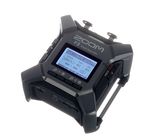
- Build quality is very good and while side panels are plastic, these are protected by the protruding metal frames. This device is like a mini Zoom F6.
- High quality latching XLR sockets.
The negatives, and bearing in mind that some of these are to a degree a limitation of the form factor:
- User experience is pretty horrible with common functions requiring multiple button menu navigation with button layouts being somewhat unintuitive. For example, to switch phantom power on or off on a channel, what might be a common task, requires six button presses.
- No dials - for space restrictions I imagine.
- Buttons are flat and unergonomic, the menu/play/stop buttons along the slanted edge are particularly awkward. A mitigation is that these flat buttons will be less likely to get damaged if the device is dropped or pulled in and out of bags.
- Uses a micro SD card - obviously to save space. These can be fragile so it's probably advisable to transfer files via USB.
- File transfer via USB is slightly slower than the more expensive F-series recorders.
- Mic input has a relatively low dynamic limit giving an 'Exceeding Maximum Input Level' warning and distortion if this is exceeded. The way around this is to set the input as line input or activate the pad on the mic if it has one.
- No minijack, plug-in power option.
- No MS decoding. Not crucial but can be handy and maybe could be added in firmware.
- The F3 comes with no accessories, no batteries, no USB cable, no SD card, no case. I guess this is to reduce waste and keep the cost down.
- There is an artefact that is produced in the ultrasonic range when the device switches between the two converters for the 32-bit float implementation. This is noticeable as a stepped change in inherent noise shortly after a loud transient. Note that this is an extremely obscure artefact, only noticeable in the extreme ultrasonic range and therefore only apparent when pitching down. This may be a consideration in sound design work. This artefact is evident in all 32-bit float Zoom F-series recorders, even when recording in 24 bit.
Neither positive or negative
- I can't comment on Bluetooth operation or timecode as I don't have the Bluetooth dongle or an iPhone.
- The LCD waveform on the single-colour screen looks nice but is probably not terribly important, particularly as you are recording in 32-bit float format. An LED would suffice in confirming that some signal is being received. Instead is might have been preferred to reduce the size of the screen in favour of bigger and more buttons
- The level recorded to each track is still set in 6dB steps (x 1, x 2, x 4 etc.). This can be useful for monitoring purposes but even when recording in stereo, the setting isn't linked across both channels so should be made for each channel to the same setting. If you forget to set them to the same level, you will have to fix it in post using the required number of 6dB increments. Crucially, if you change it after recording has started, it will be reflected in the headphones and waveforms on the screen but not in the recorded file. This could be improved in firmware.
To summarise, I do recommend this device if you only need stereo, space is at a premium and don't need to change settings on the device frequently. If you want a better user experience, have more space and can pay the extra, the Zoom F8n Pro, F6 or Sound Devices Mix Pre series are suggested.
For travel and space-restricted applications, this is the ideal device.
First, the great things about the F3:
- Very good sound quality, low noise - the same preamps as are in the rest of the 32-bit float F-series recorders.
- 32-bit float recording so there is no need to set record levels (actually, this is the only option with this device).
- Quick boot up and switch off (about 1 second).
- Can be powered from a USB powerbank.
- 2 x AA powering better than expected.
- Can be bus powered from a laptop.
- Can be used as a basic audio interface.
- XLR inputs can be configured as mic or line (jack adapters might be handy) and phantom powered in each of these modes.
- Build quality is very good and while side panels are plastic, these are protected by the protruding metal frames. This device is like a mini Zoom F6.
- High quality latching XLR sockets.
The negatives, and bearing in mind that some of these are to a degree a limitation of the form factor:
- User experience is pretty horrible with common functions requiring multiple button menu navigation with button layouts being somewhat unintuitive. For example, to switch phantom power on or off on a channel, what might be a common task, requires six button presses.
- No dials - for space restrictions I imagine.
- Buttons are flat and unergonomic, the menu/play/stop buttons along the slanted edge are particularly awkward. A mitigation is that these flat buttons will be less likely to get damaged if the device is dropped or pulled in and out of bags.
- Uses a micro SD card - obviously to save space. These can be fragile so it's probably advisable to transfer files via USB.
- File transfer via USB is slightly slower than the more expensive F-series recorders.
- Mic input has a relatively low dynamic limit giving an 'Exceeding Maximum Input Level' warning and distortion if this is exceeded. The way around this is to set the input as line input or activate the pad on the mic if it has one.
- No minijack, plug-in power option.
- No MS decoding. Not crucial but can be handy and maybe could be added in firmware.
- The F3 comes with no accessories, no batteries, no USB cable, no SD card, no case. I guess this is to reduce waste and keep the cost down.
- There is an artefact that is produced in the ultrasonic range when the device switches between the two converters for the 32-bit float implementation. This is noticeable as a stepped change in inherent noise shortly after a loud transient. Note that this is an extremely obscure artefact, only noticeable in the extreme ultrasonic range and therefore only apparent when pitching down. This may be a consideration in sound design work. This artefact is evident in all 32-bit float Zoom F-series recorders, even when recording in 24 bit.
Neither positive or negative
- I can't comment on Bluetooth operation or timecode as I don't have the Bluetooth dongle or an iPhone.
- The LCD waveform on the single-colour screen looks nice but is probably not terribly important, particularly as you are recording in 32-bit float format. An LED would suffice in confirming that some signal is being received. Instead is might have been preferred to reduce the size of the screen in favour of bigger and more buttons
- The level recorded to each track is still set in 6dB steps (x 1, x 2, x 4 etc.). This can be useful for monitoring purposes but even when recording in stereo, the setting isn't linked across both channels so should be made for each channel to the same setting. If you forget to set them to the same level, you will have to fix it in post using the required number of 6dB increments. Crucially, if you change it after recording has started, it will be reflected in the headphones and waveforms on the screen but not in the recorded file. This could be improved in firmware.
To summarise, I do recommend this device if you only need stereo, space is at a premium and don't need to change settings on the device frequently. If you want a better user experience, have more space and can pay the extra, the Zoom F8n Pro, F6 or Sound Devices Mix Pre series are suggested.
6
0
Report
h
Portable, Easy to use field recorder
It's really easy to use, the two pre-amps are solid and sound good. It's really portable but is a bit tricky to use with certain attachments, like backpack shoulder straps, as they wont fit on the back of the recorder cause of the two metal rodes. It's a very specific issue for the use I wanted.
Overall is a great small, good sounding product
Overall is a great small, good sounding product
0
0
Report