


the t.bone free solo Twin PT 823 B-Stock

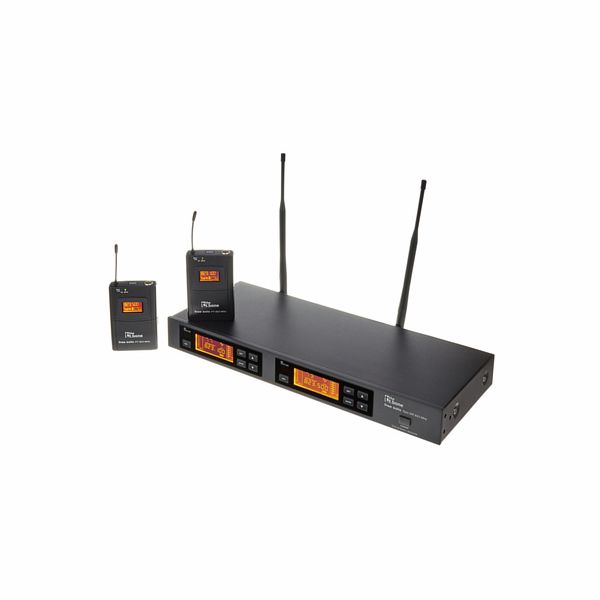
2-Channel UHF Wireless System
- With two bodypack transmitters
- Frequency range: 823 – 832 MHz
- Eight pre-programmed frequency groups with eight available channels each
- One user group with freely selectable frequencies
- Adjustable squelch with threshold display on the receiver
- Frequency scan on the receiver
- Adjustable AF output
- Adjustable transmission power: 5 mW, 10 mW, 20 mW
- Infrared transfer of the settings from the receiver to the transmitter
- Pilot tone
- 25 KHz increments
- 19" 1 U housing with 2x BNC output for antennas
- XLR and jack outputs
- Operates with 12 V / 600 mADC power supply (centre positive)
- Transmitter housing: Plastic
- 3-pin TQG connector, male
- LCD screen
- Operates with two AA batteries or rechargeable batteries
- Includes guitar cable, plastic case and rack mount
- Suitable antenna converter: Art. 177448 (not included)
-
Available since November 2016
-
Item number 408067
-
Sales Unit 1 piece(s)
Wireless set on a budget
Whether in the rehearsal room or on stage, the t.bone free solo Twin PT 823 MHz bodypack system makes it easy for musicians to say goodbye to those tangled cables. It works just as well clipped to the guitarist's waistband or attached to the strap of a bass, but it can also be used to transmit miked brass instruments such as saxophone or trumpet. At the same time, more static setups – like synthesizers or DJ mixers – can go wireless virtually effortlessly. The idea here is simple: A straightforward way to transmit instrument or line-level signals wirelessly and without fuss. Regulations differ internationally in the 823–832MHz range: In Germany and the UK, the band used here is licence-free. In other countries, operation can require registration, which is typically inexpensive and relatively straightforward, with the potential for more coordinated frequency use.
)
What's in the box?
The t.bone free solo Twin PT 823 MHz is a complete wireless system, made up of two bodypack transmitters and a stationary dual receiver. Getting started is quick and uncomplicated, even for complete newcomers to UHF wireless gear. And despite sitting in the lower price bracket, this analogue system offers a solid set of features for everyday use. The bodypack transmitters are designed for instrument and line-level signals, but they can also be used with wired microphones. In the box are a rackmount set for the receiver, two 6.3mm jack cables for connecting the receiver to a mixing desk or audio interface, and two instrument cables for linking the bodypacks (via their 3‑pin TQG connection) to a guitar, bass or similar instrument. For use with headset or lavalier microphones, an appropriate cable would be required.
)
Pro features, friendly price
The free solo bodypack transmitters are fitted with displays that make them clear and easy to operate. To prevent unwanted noise when the signal becomes weak, the squelch function can be precisely adjusted. Finding a free frequency is made simpler by the receiver's automatic frequency scan. For added stability, the system transmits not only the audio signal but also a pilot tone, which enables a number of useful functions – including allowing the transmitters' battery status to be shown directly on the receiver. And for a more professional setup overall, all components fit neatly into the supplied transport case, which is made from durable plastic and features custom-cut foam compartments for each part.
)
About the t.bone
Since 1994, the t.bone has been one of Thomann's in-house brands, and its name can be found on devices such as headphones, wireless systems, in-ear equipment, and various microphones and matching accessories. the t.bone products are made exclusively by renowned companies who also manufacture products for other well-known brands. This provides a clear advantage: Brand-quality products at very reasonable prices. And word gets around: One in seven Thomann customers has already bought at least one product from the t.bone.
Reliable and easy to use
The t.bone free solo Twin PT 823 MHz is perfect for beginners stepping into wireless technology for the first time. With all the essential functions in place and the rack kit included, it's quick to learn and straightforward in day-to-day use. Eight pre-programmed frequency groups, each with eight channels, along with an additional user-set channel, provide enough flexibility for regular wireless setups while still allowing for manual adjustment if needed. As a result, the system also works particularly well in rehearsal spaces, schools, or or anywhere there's many changing users. The transport case, the all-round solid build quality and the fact the transmitters run on standard batteries – including rechargeable ones – all add to its practical appeal (the batteries themselves are not included). Thanks to multi-channel operation, the setup can also be expanded without difficulty using the individually sold bodypack transmitters and handheld mics from the t.bone's free solo range, which are available for all frequency bands.
Information on the supported frequency ranges
Here you can see which frequencies are supported by this wireless system and the countries in which these frequencies are allowed in the future for wireless applications.
Accessories & matching items

Compare options
-
the t.bone Wireless Guitar/Bass systems at a glance
-
Display Wireless Guitar/Bass systems from kr 4250 - kr 4750
-
Go to product group Wireless Guitar/Bass systems
-
Go to product group Wireless Microphones
-
Go to product group Microphones
-
Show manufacturer details for the t.bone
-
the t.bone Microphones at a glance