


ap
Great Stereo Potential, Limited by the Effects Loop
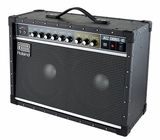
The Roland JC-40 is, on paper, an ideal solution for guitarists seeking a true stereo amplifier platform. The dual inputs preserve discrete left/right signal paths, allowing proper stereo imaging at the front end—exactly what you’d expect for time-based and modulation effects.
However, the architecture of the effects loop introduces a critical limitation. The send stage collapses the signal to mono before routing it out, effectively summing both channels. While the return reintroduces stereo, the original spatial information has already been lost. This design breaks the integrity of the stereo signal chain.
From a signal flow perspective, this forces two compromised use cases:
Either you run a mono signal into an external processor that generates stereo post-loop,
Or you maintain true stereo input but completely bypass the effects loop.
For players relying on stereo delay, reverb, or modulation units within the loop, this becomes a structural bottleneck. It limits proper gain staging and undermines the purpose of a stereo amp in a professional setup.
Tonally, however, the JC-40 remains very strong. It retains the characteristic clean headroom, fast transient response, and chorus signature associated with the JC lineage. In many ways, it does function as a compact JC-120, without sacrificing core sound quality.
However, the architecture of the effects loop introduces a critical limitation. The send stage collapses the signal to mono before routing it out, effectively summing both channels. While the return reintroduces stereo, the original spatial information has already been lost. This design breaks the integrity of the stereo signal chain.
From a signal flow perspective, this forces two compromised use cases:
Either you run a mono signal into an external processor that generates stereo post-loop,
Or you maintain true stereo input but completely bypass the effects loop.
For players relying on stereo delay, reverb, or modulation units within the loop, this becomes a structural bottleneck. It limits proper gain staging and undermines the purpose of a stereo amp in a professional setup.
Tonally, however, the JC-40 remains very strong. It retains the characteristic clean headroom, fast transient response, and chorus signature associated with the JC lineage. In many ways, it does function as a compact JC-120, without sacrificing core sound quality.
1
0
Report